
Quick Overview:
The Brisbane market in 2026 isn’t about chasing quick wins—it’s about building sustainable performance.
Landlords who succeed in this cycle will be those who:
- Treat their property like a long-term asset, not a short-term play
- Focus on income consistency over speculation
- Make informed, strategic decisions around pricing, presentation, and tenant management

Rather than relying on rapid capital gains, landlords and investors are shifting their focus toward rental performance—as price growth continues to rise but at a more moderated pace. In the recent market, success is no longer about timing the next boom, but about maximising consistent income, minimising vacancy, and making smarter, long-term decisions.
The Brisbane property market is still performing strongly in 2026—but it’s no longer the fast-paced, growth-driven environment we saw in previous years. Instead, the market is entering a more balanced phase, where strategy matters more than speed.
And landlords are already adapting.
A Clear Shift in Investor Behaviour
Rather than chasing short-term capital gains, today’s landlords are becoming increasingly focused on rental performance and stability.
Why? Because while property values are still increasing, the rate of growth has slowed. That shift is subtle, but it’s enough to change how investors think.
Instead of asking “How much will this property grow?”, the smarter question in 2026 is:
“How well will this property perform month to month?”
As a result, landlords are now:
Prioritising consistent rental income, keeping pricing competitive to avoid unnecessary vacancy, focusing on tenant quality and long-term occupancy and paying closer attention to holding costs in a higher interest rate environment
This is no longer a passive market. It’s one that rewards active decision-making.
The Rental Market Is Driving the Opportunity
One of the biggest factors behind this behavioural shift is Brisbane’s extremely tight rental market.
Recent data suggests vacancy rates sitting at around 0.8%, rental supply remains critically low. In practical terms, this means:
- Very few properties are available at any given time
- Tenants are competing strongly for listings
- Well-priced properties are leasing quickly
For landlords, this creates a clear advantage—but it’s not a free pass.
Pricing still matters.
Even in a tight market, properties that are overpriced or poorly presented can sit longer than expected. That’s why many landlords are becoming more hands-on, ensuring their properties are positioned correctly from day one.
A Two-Speed Market Is Emerging
Another trend shaping investor behaviour is the growing divide within the market itself.
Right now, Brisbane is effectively operating as a two-speed market:
- Mid-range, well-located properties continue to perform strongly
- Premium properties are seeing slower growth and increased price sensitivity
This is influencing buying decisions.
Investors are becoming more selective, focusing on properties that: appeal to a broad tenant pool, offer strong rental yields and are located in high-demand, practical areas
In short, function is outperforming prestige.
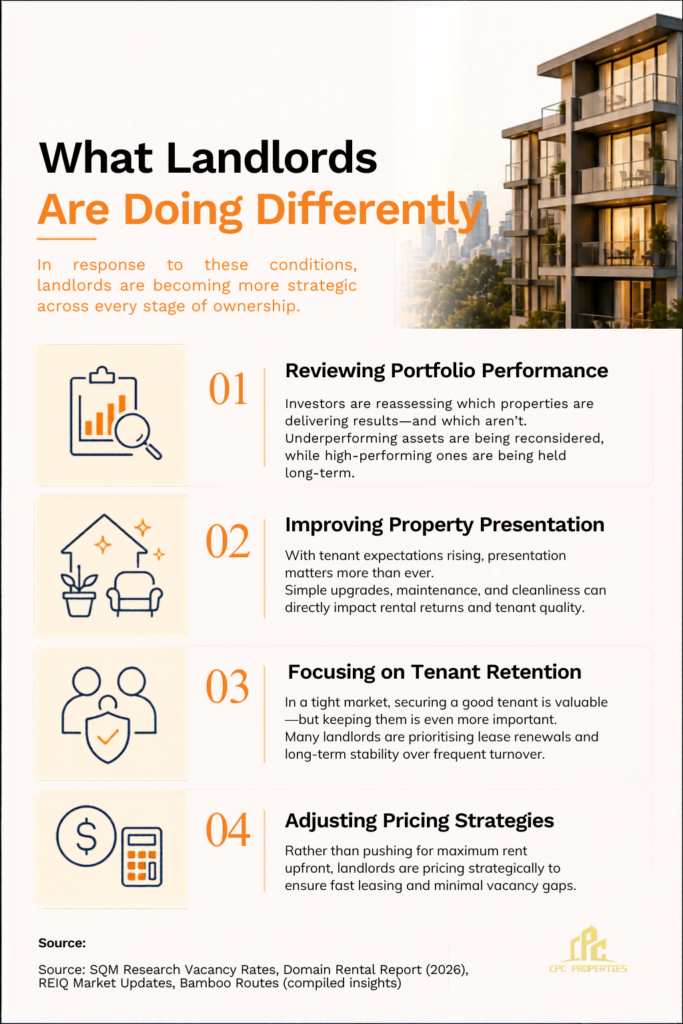
What Landlords Are Doing Differently
In response to these conditions, landlords are becoming more strategic across every stage of ownership.
1. Reviewing Portfolio Performance
Investors are reassessing which properties are delivering results—and which aren’t. Underperforming assets are being reconsidered, while high-performing ones are being held long-term.
2. Improving Property Presentation
With tenant expectations rising, presentation matters more than ever. Simple upgrades, maintenance, and cleanliness can directly impact rental returns and tenant quality.
3. Focusing on Tenant Retention
In a tight market, securing a good tenant is valuable—but keeping them is even more important. Many landlords are prioritising lease renewals and long-term stability over frequent turnover.
4. Adjusting Pricing Strategies
Rather than pushing for maximum rent upfront, landlords are pricing strategically to ensure fast leasing and minimal vacancy gaps.
Why This Matters Moving Forward
Looking ahead, the Brisbane market is expected to remain stable, with more moderate growth of around 0–3% annually.
That doesn’t signal weakness—it signals maturity.
The fundamentals are still strong: ongoing population growth, continued interstate migration, limited housing supply, high rental demand, but the way investors succeed in this environment has changed.
—–
If you have any questions or queries regarding management, selling, investment, or tenancy with CPC Properties, we’d love to hear from you. Use our Contact Form Property Sales and Management Toowong
Simply fill out our form with your enquiry, and our friendly team will respond to you as quickly as possible. Or call us on 07 3036 5246
Source: